
You are in: Claim types, then Hurricane claims FL and TX.
Hurricane claims in Florida and Texas: public adjuster rules

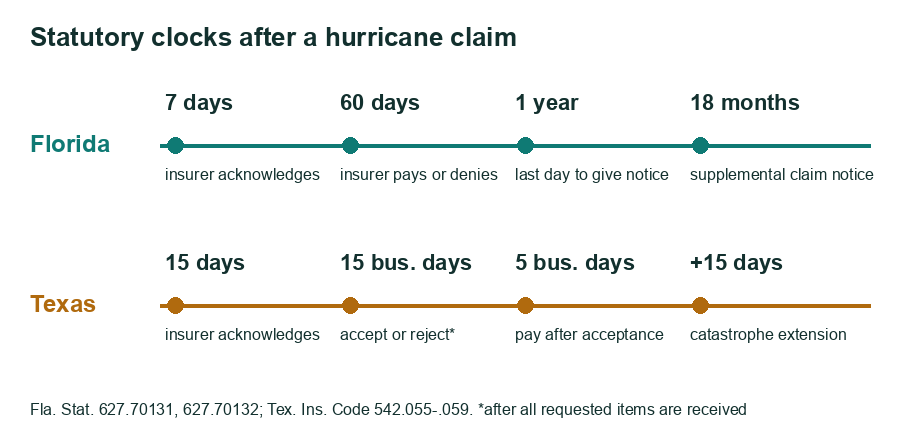
In Florida you must notify your insurer within one year of landfall, the insurer must pay or deny within 60 days, and a public adjuster may take at most 10% during the year after an emergency declaration. In Texas the cap is 10% on every claim, you have 72 hours to cancel, and insurer deadlines stretch by 15 days after a declared catastrophe.
Florida and Texas public adjuster rules, rule by rule
- Deadline to notify the insurer
- Florida: 1 year after the date of loss (landfall); 18 months for a supplemental claim (627.70132); Texas: Set by the policy; before any lawsuit, 61 days' written notice of the amount claimed (542A.003)
- Insurer must acknowledge
- Florida: Within 7 calendar days (627.70131(1)); Texas: Within 15 days, starting the investigation and requesting the forms it needs (542.055)
- Insurer inspection
- Florida: Within 30 days after receiving proof of loss (627.70131(3)); Texas: Not fixed by this subchapter
- Insurer decision
- Florida: Pay or deny within 60 days after notice (627.70131(7)); Texas: Accept or reject within 15 business days of receiving all requested items, or explain and decide within 45 more days (542.056)
- Payment after acceptance
- Florida: Within the 60-day decision period; Texas: Within 5 business days (542.057)
- Catastrophe adjustment
- Florida: Lower public adjuster fee cap for a year after a Governor's emergency declaration; Texas: Claim deadlines extended by 15 days after a weather catastrophe or major disaster (542.059)
- Public adjuster fee cap
- Florida: 10% (emergency claims, first year); 20% otherwise; 1% or 0% when the insurer pays early; Texas: 10% of the settlement; no percentage if limits are paid within 72 hours
- Time to cancel the contract
- Florida: 30 days after the loss or 10 days after signing, whichever is longer, for an emergency claim; Texas: 72 hours after signing
- Solicitation hours
- Florida: Mon-Sat, 8 a.m.-8 p.m.; Texas: 9 a.m.-9 p.m. Mon-Sat, noon-9 p.m. Sun; never during the disaster
Florida: Fla. Stat. 626.854, 627.70131, 627.70132 (2026 text). Texas: Tex. Ins. Code chapters 542, 542A and 4102 (current text from the Texas Legislative Council).
Straight answers for Gulf Coast hurricane claims
When does Florida's one-year clock start for a hurricane?
On the date the hurricane made landfall (Fla. Stat. 627.70132(3)). For a tornado, windstorm or severe rain, it is the date NOAA verifies the event. The deadline is paused while a named insured servicemember is deployed to a combat zone or combat support posting that materially affects their ability to file.
Does hiring a public adjuster stop the clock?
No. The notice deadline belongs to you. In Florida the public adjuster must make sure prompt notice is given and that the insurer receives the contract, but give notice yourself if the deadline is near.
Is there a free option before appraisal or court in Florida?
Yes. Florida's Department of Financial Services runs a mediation program for personal lines and commercial residential property claims, which you or the insurer may request before appraisal or litigation (Fla. Stat. 627.7015). Your insurer must tell you about it when you file.
Do Texas insurers get extra time after a hurricane?
Yes, 15 extra days on the claim-handling deadlines when the Commissioner defines the event as a weather-related catastrophe or major natural disaster (Tex. Ins. Code 542.059(b)).
Can a public adjuster sign the insurance cheque for me?
Not in Texas: every payment must name you as a payee and carry your own endorsement, and the adjuster may not sign for you even with your authorization (Tex. Ins. Code 4102.104(c)-(e)).
Do Florida's public adjuster rules cover my business?
Most of the detailed rules in section 626.854, including the solicitation hours and fee caps, apply only to residential property and condominium unit-owner policies (Fla. Stat. 626.854(19)). The licensing requirement itself applies to every claim.
Can the insurer's inspector turn up unannounced in Florida?
No. Anyone inspecting for the insurer must give at least 48 hours' notice to you, your public adjuster or your lawyer before scheduling a meeting or an on-site inspection, and you may refuse access if that notice was not given. You can waive the notice if you prefer.
My Texas insurer is a surplus lines company. Are the deadlines different?
Yes. An eligible surplus lines insurer has 30 business days, instead of 15 days, to acknowledge and start investigating, and 20 business days instead of 5 to pay after notice of acceptance (Tex. Ins. Code 542.055, 542.057).
What happens if a Texas insurer misses the deadlines?
An insurer that is liable for the claim and does not comply may owe interest on the claim amount at 18 percent a year, plus reasonable attorney's fees, subject to the exceptions in the statute (Tex. Ins. Code 542.060).
One more Florida detail matters after a storm season with several landfalls: the date of loss is fixed by landfall, not by when you noticed the damage. If you report damage late in the season, say which storm you believe caused it and why, and keep the photos that support it.
A hurricane claim with a public adjuster, step by step
- Secure the property and keep receipts for tarps, board-up and water extraction.
- Report the claim as soon as you can, in writing, and keep the claim number.
- Separate wind and flood damage. Rising water usually goes to a separate flood policy with its own 60-day proof-of-loss rule; see water damage claims.
- Meet the insurer's adjuster. In Florida, they must give you their name and license number in writing.
- Watch the statutory clocks in the table above, and put the dates in your calendar.
- If the estimate falls short, consider a public adjuster, mediation (Florida) or the policy's appraisal clause.
Write every deadline from the table above into a calendar the day you report, with the statute next to it, so anyone helping you can check the date against the law.
How public adjusters work after a hurricane
After a major storm, public adjusters arrive from many states, and both legislatures have shaped how they may approach you. In Florida, written advertisements must carry a bold, capitalized notice that begins "THIS IS A SOLICITATION FOR BUSINESS", gifts over $25 are banned, and any contract must be titled "Public Adjuster Contract", list the adjuster's and firm's license numbers, and be copied to the insurer within 7 days. Florida contracts must also say whether the claim is an emergency, non-emergency or supplemental claim, which is what decides the fee cap.
Florida closes several loopholes that show up after big storms. An adjuster who solicits your claim but never signs a contract with you may not charge you, or take payment from anyone else, for any service on that claim (Fla. Stat. 626.854(22)). An adjuster may not take an interest in salvaged property without your signed affidavit, and may not accept a power of attorney or contract term that lets them choose your repair contractors. In Texas, an adjuster must advertise, solicit and contract under the name on the license, unless a valid assumed-name certificate is on file (Tex. Ins. Code 4102.162).
In Texas, the contract must be on an approved form, carry "WE REPRESENT THE INSURED ONLY." in bold, and give you 72 hours to rescind. Texas adjusters may not solicit while the hurricane is still under way, and they may not sign you up mainly in order to refer you to an attorney, without intending to do the adjusting work themselves.
City detail: Houston (Harvey, Beryl), Tampa (Ian, Helene, Milton) and Miami. When you are ready, request a free match.
After a storm several kinds of adjuster call at once. Public adjuster vs insurance adjuster sets out who each one works for.
Talk to a licensed adjuster. Free match with a licensed public adjuster. Check any license yourself first. How to check a license.
Ask for a free match