
You are in: Claim types, then Public vs company adjuster.
Public adjuster vs insurance company adjuster

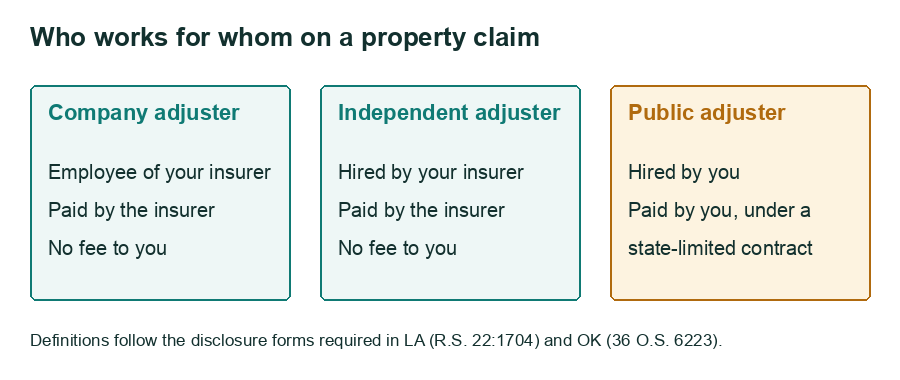
The adjuster your insurer sends, whether on staff or hired as an independent, works for the insurance company and charges you nothing. A public adjuster works only for you and is paid by you under a written, state-regulated contract. State law forbids one person from playing both roles on the same claim.
The three people who might adjust your claim
When you report damage, the insurer assigns an adjuster to investigate, measure the loss and recommend payment. That person is either a company adjuster, an employee of the insurer, or an independent adjuster, a contractor the insurer hires, often in large numbers after a hurricane. Either way, the insurer pays them.
A public adjuster is the only one of the three you hire. The disclosure Louisiana requires before a contract is signed puts it simply: public adjusters "do not work for any insurance company", and you hire them by signing a contract agreeing to pay a fee (La. R.S. 22:1704(E)). Oklahoma requires almost the same wording, and adds that company and independent adjusters "will not charge you a fee" (36 O.S. 6223(C)).
What the law says about keeping public adjuster and company roles apart
States draw a hard line between working for the insurer and working for you:
- No pretending. A public adjuster may not tell you they represent your insurer in any capacity, as an employee or as an independent adjuster (La. R.S. 22:1693(B); 36 O.S. 6223(A); N.C. Gen. Stat. 58-33A-10(b); C.R.S. 10-2-417(1)(b)).
- No double dipping. In Colorado and North Carolina, a public adjuster who accepts an appointment from the insurer on your claim may not charge you a fee for it. South Carolina bars a fee to a claimant while the adjuster is simultaneously appointed by any insurer. Texas bars a license holder from charging you while representing the carrier your claim is against (Tex. Ins. Code 4102.158(c)).
- No switching sides on the same claim. Colorado and South Carolina say a licensed public adjuster may not act as a company or independent adjuster on the same claim. Louisiana goes further: while the public adjuster license is held, the person may not work as a company or independent adjuster in the state at all.
- Loyalty. Colorado, Louisiana, Oklahoma and South Carolina all say a public adjuster must serve the client's interest alone.
Nor may a public adjuster cut the insurer out. In Florida, the public adjuster must make sure the insurer gets prompt notice, a copy of the contract, access to inspect, and the chance to interview you, and may not obstruct a timely inspection (Fla. Stat. 626.854(15)). Louisiana requires a notification letter, signed by you, to tell the insurer that a contract exists, and says that letter does not stop you from talking to the insurer directly.
Confidentiality cuts the same way. A Texas public adjuster may not divulge information obtained on your claim to anyone else, except as the law requires or at your direction (Tex. Ins. Code 4102.153).
Whose claim a public adjuster works on
Public adjusters handle first-party property claims: your claim against your own policy for damage to your home, its contents or your business property. They are not for:
- injury claims (Florida, Texas and Louisiana rule these out);
- claims against someone else's insurer as a third party, in Louisiana and Texas;
- motor vehicle claims, which Louisiana's definition excludes.
The company adjuster, by contrast, handles every kind of claim the insurer receives. Florida also requires the insurer's adjuster to give you a document with their name and state license number when inspecting, and to repeat that information in later communications (Fla. Stat. 627.70131(3)).
Remember, too, that the insurer's adjuster and your public adjuster are expected to deal with each other. Florida says the insurer may not exclude your public adjuster from its in-person meetings with you, and that both must meet or communicate in an effort to agree on the scope of the covered loss (Fla. Stat. 626.854(15)(a)).
Records that show who you hired
If there is ever a dispute about who represented you, these papers answer it:
- the public adjuster contract, which Texas requires to say "WE REPRESENT THE INSURED ONLY." in 12-point bold type;
- the separate disclosure explaining the three adjuster types, signed before the contract in Florida, Louisiana and Oklahoma;
- the insurer's adjuster's name and license number, which Florida requires on inspection documents;
- the notification letter to the insurer, where your state requires one.
Deciding whether you need your own public adjuster
- Report the claim to your insurer yourself, promptly and in writing, whatever you decide about help.
- Let the insurer's adjuster inspect. Ask for their name, whether they are staff or independent, and their license number.
- Read the estimate when it arrives. Compare it with what was actually damaged, room by room.
- Consider a public adjuster when the loss is large or complicated (a fire with smoke through the whole house, water inside walls, a hurricane loss involving several coverages), or when the estimate seems to leave things out.
- Check the license and read the fee terms before signing, using our license guide and fee table.
What each adjuster costs you, and how fast a claim moves
The insurer's adjuster costs you nothing directly. A public adjuster's fee comes out of your settlement, within the limits your state sets: up to 10 percent of any settlement in Texas and South Carolina; 10 or 20 percent in Florida depending on whether the claim comes from a declared emergency; no percentage at all in Louisiana.
The insurer's deadlines run regardless of who represents you. Florida insurers must acknowledge a claim communication within 7 days and pay or deny within 60 days of notice (Fla. Stat. 627.70131). Texas insurers must acknowledge and start investigating within 15 days, then accept or reject within 15 business days of receiving everything they asked for (Tex. Ins. Code 542.055, 542.056). A public adjuster in Florida must give you and the insurer a written, itemized estimate within 60 days of the contract, or you may cancel (Fla. Stat. 626.854(12)).
Misunderstandings to avoid
- Assuming the insurer's adjuster is neutral. They are paid by the insurer. That does not make them unfair, but their job is to assess the claim for the company.
- Assuming you must stop talking to your insurer. Louisiana's required disclosure says you always have the right to communicate directly with your insurer, and a public adjuster may not restrict that.
- Hiring a contractor who offers to "handle the insurance". In Florida and Texas, a contractor may not act as a public adjuster on property it is or may be repairing.
- Letting either adjuster settle without you. Oklahoma and Colorado say a public adjuster may not agree to any settlement without your knowledge and consent, and Louisiana and South Carolina require that consent in writing.
- Expecting a public adjuster to take your insurer to court. Public adjusters negotiate; they do not litigate. Louisiana forbids them from filing any complaint in court or with a state agency for a client, and Florida, Texas and Louisiana all bar them from giving legal advice. If the dispute turns into a lawsuit, you will need a lawyer.
Ready to talk to someone on your side? Our matching request sends your details to a licensed public adjuster in your state. For storm-specific advice, see hail and wind claims.
Talk to a licensed adjuster. Free match with a licensed public adjuster. Check any license yourself first. How to check a license.
Ask for a free match