
You are in: Claim types, then Fee caps by state.
Public adjuster fee caps by state

Most storm states cap what a public adjuster may take. Texas and South Carolina allow at most 10% of the settlement on any claim. Florida allows 10% on claims from a declared emergency during the first year and 20% otherwise. Colorado, Oklahoma and North Carolina cap fees at 10% only after catastrophes. Louisiana bans percentage fees outright.
A public adjuster is paid by you, the policyholder, usually as a share of what the insurer pays on the claim. Because that share comes out of money meant to rebuild a house, legislatures in the hurricane, hail and wildfire states have written limits into their insurance codes. The table below sets out the limits we could confirm from the statute text itself, as of November 13, 2026.
| State | Fee limit | Time to cancel without penalty | Where it is written |
|---|---|---|---|
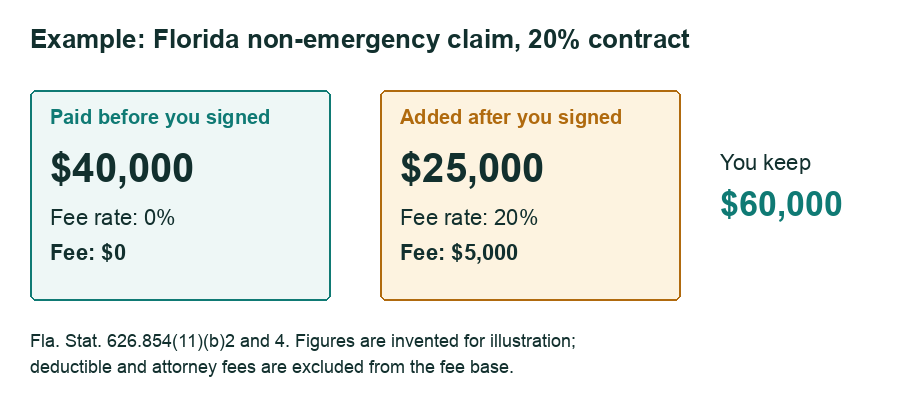
| Florida | 10% of payments on claims from a Governor-declared emergency, for claims made in the year after the declaration; 20% on other claims; 1% on a coverage part the insurer pays or commits to pay in full within 14 days of the loss (or 10 days of signing, if later); 0% on anything the insurer paid or agreed to pay before you signed. Reopened or supplemental claims: 20% of new money only. | 10 days after signing. After a declared emergency: 30 days after the loss or 10 days after signing, whichever is longer. | Fla. Stat. 626.854(7), (11) |
| Texas | 10% of the settlement on any claim. No percentage fee at all if the insurer pays or commits in writing to pay the policy limit within 72 hours of the loss report. | 72 hours after signing, in writing. | Tex. Ins. Code 4102.103(b), 4102.104 |
| Louisiana | A "reasonable fee" only. A fee that is contingent on, or a percentage of, the claim makes the contract null and void. | Three business days after signing, in writing. | La. R.S. 22:1703(A), 22:1704(H) |
| South Carolina | 10% of any settlement, on every claim (new law effective May 19, 2026). No fee or deposit before settlement. | Five business days after signing, by mail, email or delivery. | S.C. Code 38-92-120(E), 38-92-130(I) |
| North Carolina | 10% after a catastrophic incident, with nothing taken before settlement. No percentage fee if the insurer pays or commits to pay the policy limit within 72 hours. | Three business days after signing. | N.C. Gen. Stat. 58-33A-60(d), 58-33A-65 |
| Colorado | 10% after a catastrophic disaster, with nothing taken before settlement. | 72 hours after signing, by mailed notice to the adjuster and the insurer. | C.R.S. 10-2-417(4), (6)(i)(IV) |
| Oklahoma | 10% on claims from a catastrophe the Insurance Commissioner has declared an emergency (does not apply to work for for-profit businesses). Time-and-expense pay only if the insurer pays or commits to pay a coverage limit within 72 hours. | Until midnight of the third business day after you receive the signed agreement. | 36 O.S. 6218(C), 6216.2 |
| California | The fee may not leave you with less than the insurer had already paid before you signed. Check the current percentage rules with the California Department of Insurance (1-800-927-4357). | Three business days; five calendar days if the contract arose from a catastrophic disaster (per the Department's disclosure form). | Cal. Ins. Code 15027; CDI disclosure form |
Sources: Florida Senate statutes (2026 edition); Texas Legislative Council statute documents; Louisiana State Legislature; South Carolina Code of Laws, Title 38 Chapter 92; North Carolina General Assembly, Chapter 58 Article 33A; Colorado Revised Statutes 2024; Oklahoma Statutes Title 36; California Department of Insurance. States not listed have not been reviewed yet; ask that state's insurance department.
Working out the fee on your own claim
A cap is a ceiling, not a price list. Adjusters may charge less, and many contracts state a percentage below the limit. To see what a given contract would cost you, go through these steps with the contract in hand.
- Find the stated rate. Florida requires the percentage in 18-point bold type just above your signature. Oklahoma requires the exact percentage and your initials beside it. If you cannot find a clear number, do not sign.
- Ask what the fee is calculated on. In Florida, the fee cannot be charged on your deductible, and additional living expenses are excluded unless you sign a separate agreement covering them.
- Subtract money already paid or promised. Florida sets the fee at zero on any coverage part the insurer paid or agreed in writing to pay before the contract. California's rule is that the fee cannot leave you with less than the insurer had paid before you signed.
- Check for a declared emergency. In Florida, Colorado, North Carolina and Oklahoma the lower catastrophe cap depends on an official declaration. Ask the adjuster which declaration applies and write it on your copy.
- Look for a quick policy-limits payment. Texas, Louisiana, North Carolina and Oklahoma switch the adjuster to reasonable hourly pay if the insurer pays or commits to the policy limit within 72 hours of the report. South Carolina's window is five business days, and Florida cuts the fee to 1 percent on a coverage part paid in full within 14 days of the loss.
How much a public adjuster costs, and when you pay
The fee normally comes out of each insurance payment as it arrives, not all at once. Louisiana, North Carolina and Oklahoma forbid contract terms that let an adjuster take the whole fee from the first cheque, or collect it on money that is owed but not yet paid. Colorado and North Carolina after a catastrophe, and South Carolina on every claim, bar any fee, retainer or deposit before the claim is settled.
Payment usually travels through a joint cheque. Oklahoma requires the insured to be named as a joint payee on any claim payment that involves a public adjuster, and Texas requires the insured's name and endorsement on every payment draft, with no adjuster allowed to sign for you.
Timing also matters for your own deadlines. Florida bars a claim unless you give notice within one year after the date of loss, or 18 months for a supplemental claim (Fla. Stat. 627.70132). Hiring an adjuster does not stop that clock, so give notice to the insurer yourself if you are close to the deadline.
Which claims the fee limits cover
The caps protect people who own or insure property and hire an adjuster for a first-party claim against their own insurer. Some carve-outs are worth knowing:
- Florida's detailed contract and fee rules in subsections (5) through (18) of section 626.854 apply to residential property and condominium unit-owner policies, not commercial policies.
- Oklahoma's 10 percent catastrophe cap does not apply when the adjuster works for a for-profit commercial entity.
- Texas licenses cover fire, allied lines, burglary, flood and other property claims, but only for a client who is an insured under the policy (Tex. Ins. Code 4102.101).
- Public adjusters in Florida, Texas and Louisiana may not handle bodily-injury claims.
Paperwork that shows a fee is lawful
If a fee is ever disputed, the documents decide it, and every state on the table requires a written contract. Keep these:
- The signed contract. Texas requires a form approved by the Commissioner, signed in duplicate. Louisiana and Oklahoma require the title "Public Adjuster Contract", the adjuster's license number and the full fee. Florida adds the firm's license number, your initials on every page and the type of claim (emergency, non-emergency or supplemental).
- The separate disclosure. Florida, Louisiana and Oklahoma require a signed statement, before the contract, explaining company, independent and public adjusters, and saying you do not have to hire one.
- Every payment record. Compare each cheque against the agreed percentage. Oklahoma and South Carolina require an adjuster to disclose in writing any compensation received from third parties for your loss.
- Your cancellation notice, if you sent one. Florida asks for certified mail with return receipt or another mailing with proof. Colorado wants the notice mailed to both the adjuster and the insurer.
Public adjuster fee mistakes that cost homeowners money
- Signing during the storm. Soliciting during the event itself is barred in Texas, Louisiana, Colorado, Oklahoma, North Carolina and South Carolina. California also bars contact between 6 p.m. and 8 a.m. unless you ask for it. A knock on the door while the wind is still blowing is a warning sign.
- Paying a percentage on money already in hand. If the insurer has already paid, ask in writing how the contract treats that amount.
- Missing the cancellation window. These windows are short. Seventy-two hours in Texas runs from your signature, not from when you read the contract.
- Accepting gifts or deductible offers. Florida bars gifts over $25, loans and advances, and any rebate or deductible waiver offered in exchange for a roof inspection or claim. South Carolina bars offers to pay or waive the deductible.
- Letting the adjuster pick your contractor. Florida, Louisiana, Colorado and Oklahoma forbid contracts that give the adjuster power to choose who does the repairs, and South Carolina bars referrals to repairers the adjuster profits from.
Public adjuster fee caps, summed up for Texas, Florida and the rest
A public adjuster works for you and is paid by you. The pay is limited by state law, usually to 10 percent in a declared catastrophe and, in Texas and South Carolina, on every claim. Florida allows up to 20 percent outside an emergency year, and Louisiana allows no percentage at all. The limit is applied only to money the adjuster helps recover, and the contract must spell out the rate. Read the rate, read the cancellation clause, and check the license before you sign. Our license-check guide shows how, and the state pages for Florida and Texas go further into each state's rules. When you are ready, request a free match with an adjuster licensed where your property is.
Talk to a licensed adjuster. Free match with a licensed public adjuster. Check any license yourself first. How to check a license.
Ask for a free match